
Medical Vacuum System & Central Hospital Suction Plant
Engineered for continuous clinical suction across Operation Theatres, ICUs, and emergency resuscitation bays. Configured with duplex or triplex oil-lubricated rotary vane or dry claw pumps, dual parallel bacterial filtration trains, and intelligent PLC lead/lag automation.
9 Certified Medical Vacuum Plant Configurations
Explore our proven hospital vacuum systems, vacuum receiver buffer vessels, bacterial filter trains, and PLC automation stations commissioned in government medical colleges and private multi-specialty hospitals.
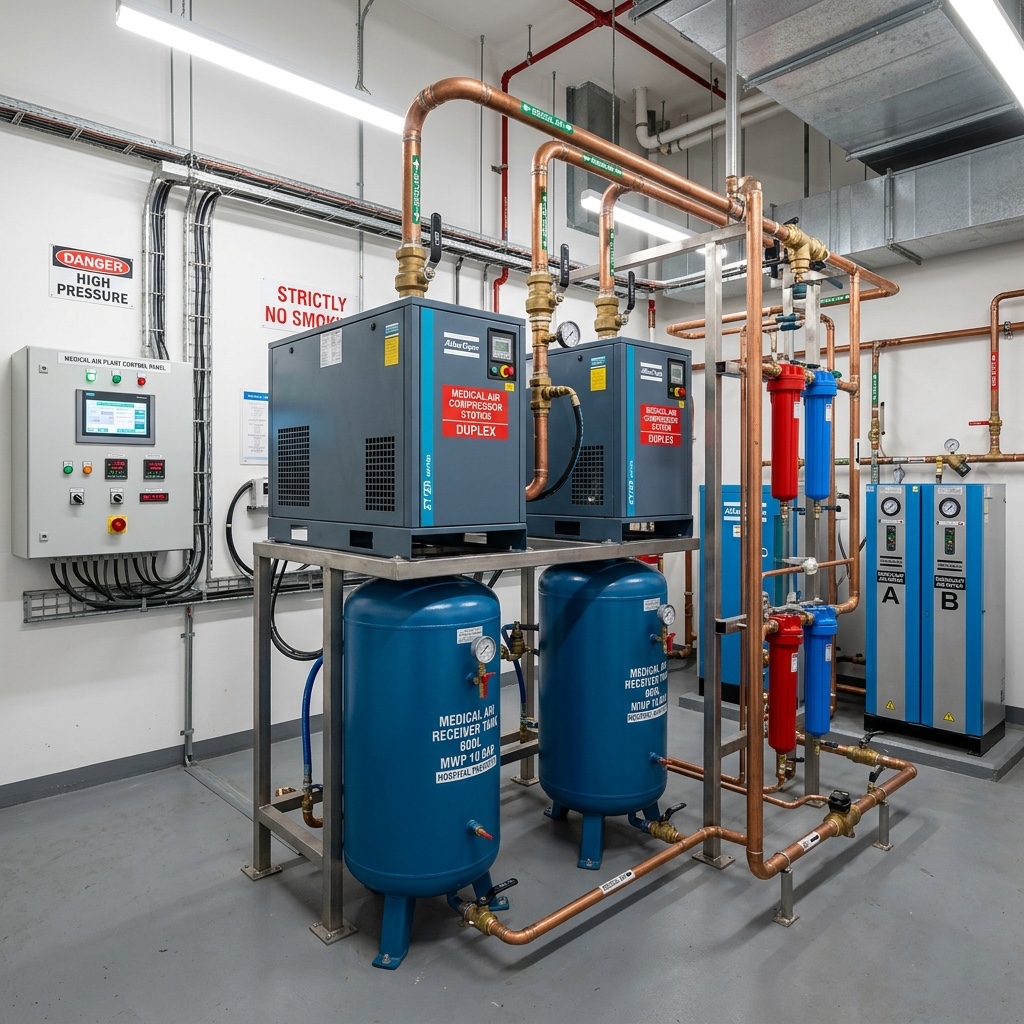
Duplex Medical Rotary Vane Vacuum Pump Package
HTM 02-01 and ISO 7396-1 compliant twin oil-lubricated rotary vane vacuum pumps with automatic lead/lag alternation, delivering high volumetric displacement and stable negative pressure down to -650 mmHg.
Clinical Grade Suction Reliability & Biohazard Control
Engineered according to strict HTM 02-01, ISO 7396-1, and NFPA 99 medical gas standards to deliver uninterrupted surgical suction with zero cross-contamination.
Stable Deep Negative Pressure
Guarantees continuous pipeline suction between -450 mmHg and -650 mmHg (-60 kPa to -87 kPa), maintaining instant clinical suction flow at all OT and ICU wall terminal units simultaneously.
99.999% Dual Bacterial Filters
Twin parallel filter columns with BS 3928 sodium flame test certification. Each filter includes a transparent drainage flask to capture bodily fluid carryover, with isolation valves for live element replacement.
N+1 Emergency Redundancy
Strict multi-pump engineering ensures that even if the primary pump fails or enters scheduled servicing, the standby pump automatically assumes 100% of peak hospital suction demand with zero lag.
Intelligent PLC & Lead/Lag Staging
Integrated programmable controller rotates the lead pump duty cycle on each start to equalize running hours, monitors motor thermal overloads, and triggers remote audible/visual alarms to hospital BMS.
Internal Epoxy Coated Receivers
Heavy-gauge vertical vessels with dual-layer internal antimicrobial epoxy lining resisting condensation corrosion and bodily fluid vapors. Complete with bottom manual sludge blowdown ball valves.
Acoustic Silencer & Exhaust Ducting
Heavy-duty exhaust line silencers dampening operational pulsating noise below 68 dBA, directing biohazard exhaust air safely through sealed copper risers to the hospital roof away from HVAC intakes.
Transparent Medical Vacuum Plant Pricing (India)
Direct factory supply packages and central hospital suction tender pricing. Fully aligned with GeM portal BOQ criteria, HTM 02-01 standards, and state healthcare infrastructure allocations.
Compact Simplex Vacuum System
- Capacity: 100 to 300 LPM Flow Rate
- Single Oil-Lubricated Rotary Vane Pump
- 150L to 300L Vertical Epoxy Buffer Receiver
- Single Bacterial Filter with Glass Drain Trap
Duplex Medical Vacuum Plant (HTM 02-01)
- Capacity: 500 to 1,500 LPM Displacement
- Twin Rotary Vane or Dry Claw Pumps (Duty/Standby)
- 500L to 1,000L Vertical Vacuum Receiver Vessel
- Dual Bacterial Filters + PLC Auto-Alternation Panel
Triplex / Quadruplex Suction Plant
- Capacity: 2,000 to 5,000+ LPM High Volume
- Triplex / Quadruplex Pumps with Full N+1 Standby
- 1,500L to 3,000L Heavy Industrial Receiver Tanks
- Color Touchscreen HMI + BMS Modbus/BACnet Export
Turnkey Plant & Rooftop Exhaust Suite
- Full Plant Room Civil Rigging & Anti-Vibration Base
- Degreased Medical Copper Headers & Room Risers
- Rooftop Biohazard Exhaust Silencers & Ducting
- 24-Hour Vacuum Decay Testing & NABH Handover
Head-to-Head 10-Competitor Vacuum System Matrix
A detailed technical evaluation comparing Bio Meditech against major medical gas vacuum manufacturers across pump technology, international code compliance, bacterial filter efficiency, control automation, and local UP technical service.
| Brand / System | Pump Technology | Standards Compliance | Bacterial Filter Train | Control Architecture | Exhaust Noise Level | UP Field Service | Price Benchmark |
|---|---|---|---|---|---|---|---|
| Bio Meditech (BM-MVS Series) | Duplex/Triplex Vane & Dry Claw | HTM 02-01, ISO 7396-1, NFPA 99 | Dual 99.999% HEPA + Borosilicate Flasks | Touchscreen PLC + Lead/Lag Equalizer | < 68 dBA (Enclosed) | < 4 Hours (Lucknow Hub) | ₹2,80,000 – ₹16,50,000 (Direct Factory) |
| Atlas Copco (mV Series) | Rotary Vane & Claw (mV) | ISO 7396-1, HTM 02-01 | Proprietary Filter Housing | Elektronikon Controller | 65 – 70 dBA | 24 – 48 Hours | ₹8,50,000 – ₹32,00,000 |
| BeaconMedaes (Lifeline) | Rotary Vane / Claw Package | HTM 02-01 / NFPA 99 | Dual Filter with Drain Can | TotalAlert Embedded Console | 70 – 74 dBA | 48 – 72 Hours (Depot based) | ₹9,80,000 – ₹36,00,000+ |
| Busch Vacuum (Mink / R5) | R5 Rotary Vane / Mink Claw | ISO 7396-1 Standard | Hospital Filter Train | Busch Central Control | 68 – 72 dBA | 24 – 48 Hours | ₹7,20,000 – ₹28,00,000 |
| Pneumatech (PMV Series) | Rotary Vane Skid | HTM 02-01 European | Standard HEPA Bacterial | Digital Microprocessor | 70 – 75 dBA | 48 – 72 Hours | ₹6,50,000 – ₹24,00,000 |
| Ohio Medical (Amvex) | Oil-less Rotary Vane / Claw | NFPA 99 Compliant | Dual Bacterial System | PLC with Color Screen | 70 – 76 dBA | Overseas Parts / Third-Party | ₹11,00,000 – ₹42,00,000 |
| Amico (Alert-1 Plant) | Duplex / Triplex Claw | NFPA 99 / CSA Standard | Amico HEPA Canister | Touchscreen Master Panel | 69 – 73 dBA | Metro Only | ₹10,50,000 – ₹38,00,000 |
| GCE Healthcare (Mediline) | Rotary Vane Modular | HTM 02-01 Standard | Medical Gas Filter Kit | Microcontroller Panel | 72 – 76 dBA | 36 – 72 Hours | ₹5,80,000 – ₹22,00,000 |
| Narang Medical (NET MGPS) | Basic Vane Assembly | Basic Domestic Norms | Single Line Filter | Relay Contactor Panel | > 78 dBA (Unenclosed) | Transporter Dispatch | ₹2,20,000 – ₹8,50,000 |
| United Poly (Suction Plant) | Rotary Vane Duplex | Standard Indian Norms | Dual Filter Assembly | Microprocessor Base | 74 – 78 dBA | 24 – 48 Hours | ₹2,90,000 – ₹9,80,000 |
6-Step Turnkey Delivery, Rigging & Commissioning
How Bio Meditech engineers complete central hospital vacuum plant room integration, piping hookups, electrical interlocks, and 24-hour vacuum decay testing for NABH accreditation.
Hospital Suction Flow & Sizing Audit
Biomedical flow audit calculating concurrent demand across all OT tables, ICU beds, endoscopy suites, and wards using HTM 02-01 diversity factor tables to determine exact LPM capacity and receiver vessel volume.
Plant Room Rigging & Vibration Isolation
Positioning the heavy-duty pump skid and receiver tank on spring or neoprene anti-vibration inertia mountings to prevent mechanical vibration from transmitting into patient care buildings.
Copper Header & Dual Bacterial Train Hookup
Brazing degreased medical copper suction headers under nitrogen purge, connecting full-bore brass isolation valves, non-return valves, and dual parallel 99.999% HEPA bacterial filter columns.
PLC Wiring, Interlocks & Auto-Alternation Test
Wiring 3-phase power supply, motor overload protection circuits, and pressure transducer signals. Testing lead/lag auto-switchover and automatic secondary pump startup upon sudden vacuum drops.
24-Hour Vacuum Decay & Performance Test
Pressurizing the entire network to maximum vacuum (-80 kPa) and conducting a standardized 24-hour decay hold test to guarantee pipeline hermetic integrity, ensuring zero air in-leakage.
Biomedical Staff Training & NABH Handover
Hands-on training for hospital maintenance technicians on drainage flask sterilization, bacterial filter element swapping, oil level checks, and providing stamped NABH compliance test dossiers.
Medical Vacuum System Procurement & Technical FAQs
Clear technical, clinical, and regulatory answers for hospital administrators, MGPS engineers, and project consultants.
What is the difference between rotary vane and dry claw medical vacuum pumps?
Oil-lubricated rotary vane pumps use circulating vacuum oil to create an airtight seal inside the compression chamber. They provide high ultimate vacuum levels (-650 mmHg) at a lower initial capital cost, but require scheduled oil changes and oil separator element replacements. Dry claw vacuum pumps use two contactless claw-shaped rotors that rotate in opposite directions without touching or requiring lubricating oil. They offer superior energy efficiency, lower lifecycle maintenance, and zero oil contamination in exhaust air, making them ideal for green hospitals.
What is the price of a medical vacuum plant in India?
In India, central medical vacuum plant pricing ranges from ₹1,20,000 to ₹2,40,000 for compact simplex clinic units (100–300 LPM); ₹2,80,000 to ₹6,50,000 for standard duplex rotary vane or dry claw packages (500–1500 LPM with 500L–1000L receiver); ₹7,20,000 to ₹16,50,000 for high-volume triplex/quadruplex hospital stations (2000–5000+ LPM with N+1 redundancy); and ₹14,00,000 to ₹28,00,000+ for complete turnkey hospital plant rooms with copper headers and rooftop exhaust lines. Bio Meditech provides direct factory pricing and GeM tender BOQ quotations.
Why are dual bacterial filters with drainage flasks required by HTM 02-01?
Under HTM 02-01 and ISO 7396-1 standards, surgical suction lines pull infected bodily fluids and airborne pathogens from patients. Dual bacterial filters ensure that infectious bio-aerosols (bacteria, viruses) are captured with 99.999% efficiency before entering the vacuum pumps, preventing equipment contamination and toxic environmental discharge. Transparent borosilicate drainage flasks collect liquid carryover and can be autoclaved. The dual-path parallel layout allows filter replacement without interrupting hospital suction.
What is the standard pipeline vacuum level maintained at hospital bed terminals?
The central vacuum plant maintains a receiver pressure between -450 mmHg and -650 mmHg (-60 kPa to -87 kPa). At point-of-use bedside terminal outlets in the ICU and Operation Theatre, a minimum vacuum level of -400 mmHg (-53 kPa) is maintained under full design flow, ensuring instantaneous aspiration for surgical suction units and thoracic drainage systems.
What is a 24-hour vacuum decay test and why is it mandatory for NABH?
A vacuum decay test measures the hermetic tightness of the entire hospital suction pipeline network. After isolating the pump system, the pipeline is evacuated to -80 kPa (-600 mmHg) and locked for 24 hours. Under NABH and HTM 02-01 regulations, the pressure rise (loss of vacuum) over 24 hours must not exceed 20 mmHg (2.7 kPa), verifying that no atmospheric air is leaking into the sterile medical gas distribution infrastructure.
Does Bio Meditech provide turnkey installation, spare parts, and AMC in Uttar Pradesh?
Yes. Headquartered in Lucknow, our biomedical engineering fleet carries out turnkey plant room rigging, inertia base casting, degreased medical copper header brazing, electrical automation commissioning, and annual AMC/CMC service contracts across Lucknow, Kanpur, Varanasi, Gorakhpur, Prayagraj, and throughout North India with a guaranteed 4-hour on-site response time.
Design Your Hospital Medical Vacuum Plant
Speak directly with our medical gas pipeline engineers in Lucknow. Request customized hospital BOQ designs, suction flow calculations, or GeM tender specifications.