CSSD Setup & Turnkey Hospital Solutions in Lucknow & India
Bio Meditech provides complete CSSD setup, CSSD equipment supply, workflow planning, installation, and turnkey hospital infrastructure solutions in Lucknow and across India. We assist hospitals, nursing homes, medical colleges, emergency centers, and private healthcare facilities in developing certified, highly organized Central Sterile Supply Departments tailored to their operational capacity. A Central Sterile Supply Department (CSSD) is the operational heart of hospital hygiene and infection control. Proper instrument reprocessing requires a seamless, unidirectional workflow covering receiving, decontamination, ultrasonic washing, automated disinfection, instrument inspection, sterile packaging, high-pressure steam autoclaving, sterile storage, and distribution. Whether you are planning a new CSSD, upgrading an existing department, expanding your hospital bed capacity, or establishing a complete turnkey hospital project — Bio Meditech coordinates every stage from spatial zoning and utility piping to equipment selection, commissioning, and validation. Our solutions comply with international standards (EN 285 steam sterilizer standards, ISO 15883 washer disinfector guidelines, ISO 13485, and NABH accreditation criteria).
Key Components of a Modular Operation Theatre
A NABH-compliant Modular OT integrates multiple precision-engineered subsystems. Here are the critical components that Bio Meditech supplies and installs:
CSSD Layout & Workflow Planning
Unidirectional spatial planning dividing the CSSD into strict dirty (decontamination), clean (inspection & packing), and sterile (autoclaving & storage) zones to eliminate cross-contamination risks.
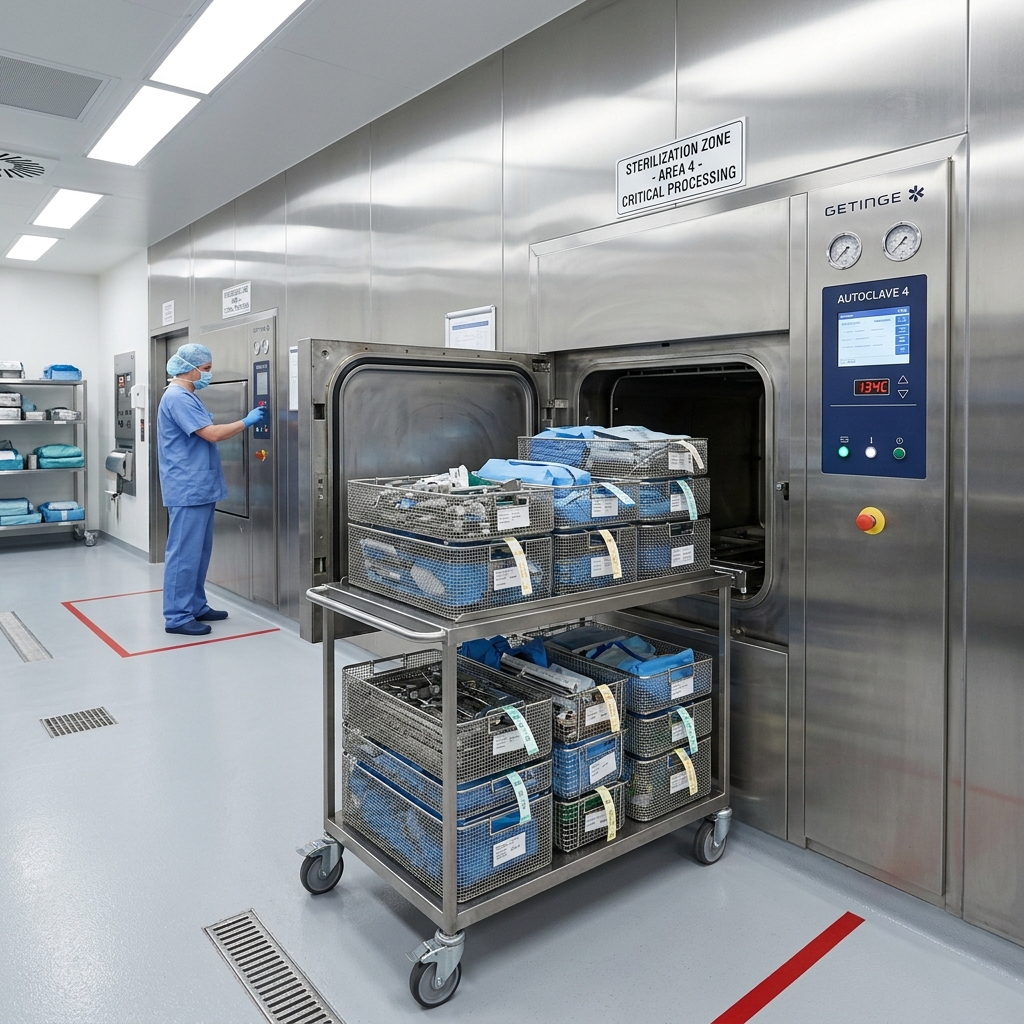
CSSD Autoclaves & Steam Sterilizers
High-pressure, dual-door pass-through steam sterilizers operating at 121°C and 134°C with digital cycle logging, vacuum pulse drying, and independent temperature sensor validation.
Automated Washer Disinfectors
Automated cleaning equipment operating under ISO 15883 standards, using thermal disinfection (90°C–93°C) and enzymatic dosing to remove organic matter before sterilization.
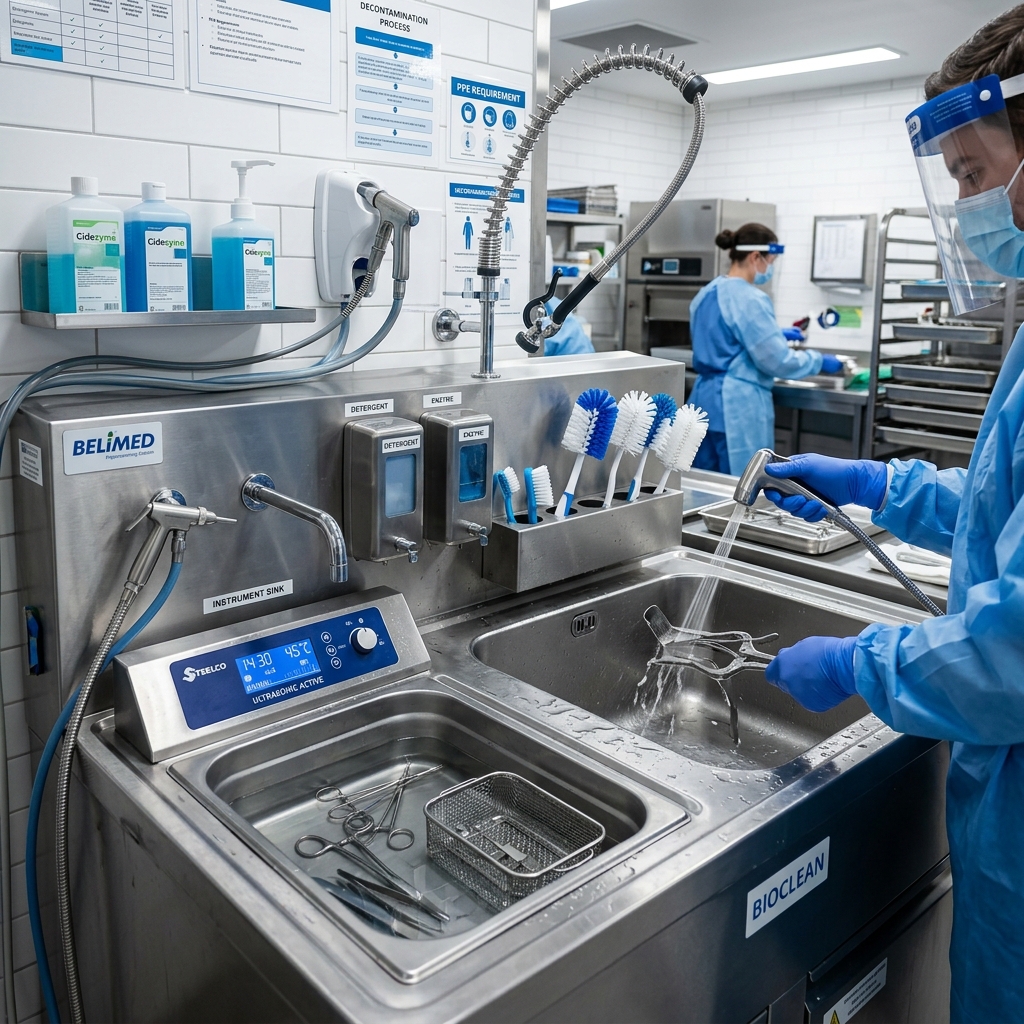
Ultrasonic Cleaning Systems
High-frequency ultrasonic tanks (28kHz–40kHz) that generate micro-cavitation bubbles to scrub biological debris from hard-to-reach joints, hinges, and box locks of surgical instruments.
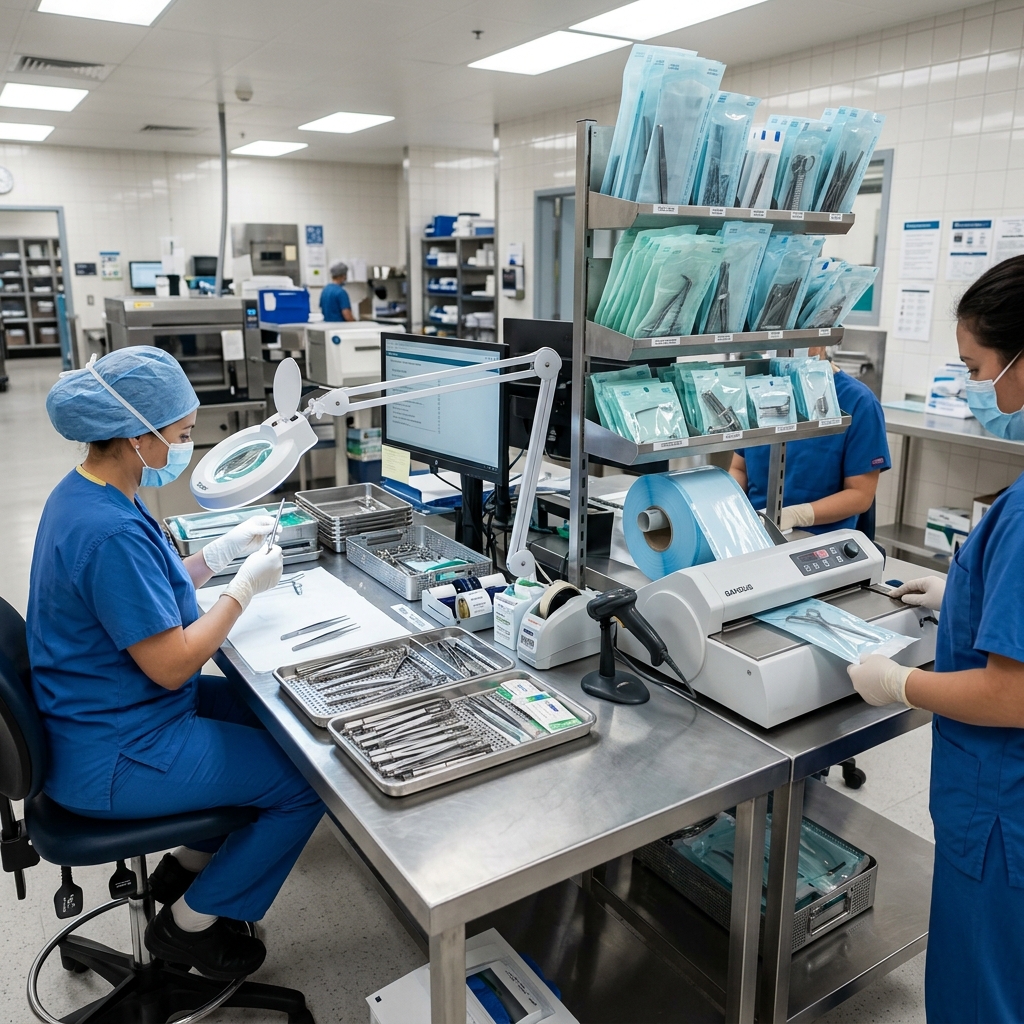
Packing & Inspection Workstations
Ergonomic SS 304 workstations with illuminated magnification, heat sealers, and pouch dispensers for inspecting, assembling, and packaging surgical sets.
Sterile Storage & Distribution Systems
Dust-free, humidity-controlled sterile storage cabinets, modular SS 304 wire shelving, and color-coded distribution trolleys to maintain pack sterility until surgery.
Pass-Through Hatches & Cleanroom Barriers
Dual-interlocked pass-through hatches and sliding windows between clean zones that preserve positive air pressure gradients and prevent air exchange.
Turnkey Hospital Infrastructure Integration
Seamless coordination with related hospital departments: Modular Operation Theatres (MOT), Medical Gas Pipeline Systems (MGPS), ICU Setup, and Hospital Furniture.
Key Features & Scope
Complete CSSD spatial layout designing and architectural zoning following NABH and WHO guidelines.
Supply and installation of EN 285 compliant steam autoclaves (horizontal, vertical, pass-through).
Supply of automated washer disinfectors, ultrasonic cleaners, and multi-bay washing sinks.
Installation of SS 304 packing tables, heat sealers, illuminated magnifying lamps, and pouch cutters.
Erection of interlocked pass-through hatches and cleanroom barrier partitions.
Supply of sterile storage shelving, enclosed transport carts, and instrument loading trolleys.
High-pressure steam piping, soft water feed integration, electrical wiring, and exhaust ducting.
Validation testing (DOP/PAO filter testing, Bowie-Dick steam tests, vacuum leak checks, biological indicator trials), and staff operational training.
Products Supplied with Modular OT
This comprehensive solution package incorporates the supply, positioning, and integration of the following equipment. Click any product to view full specifications:
Benefits
- ✓
Unidirectional Infection Control: Strict three-zone barriers (dirty, clean, sterile) completely eliminate cross-contamination of surgical instruments.
- ✓
Automated & Traceable Sterilization: Microprocessor-controlled autoclaves print exact cycle logs (temperature, pressure, duration) for audit compliance.
- ✓
High Instrument Throughput: Fast-cycle autoclaves and automated washer disinfectors enable rapid instrument turnaround for high-volume OTs.
- ✓
Medical-Grade SS 304 Construction: All counters, sinks, tables, and trolleys feature non-corrosive, seamless stainless steel built for heavy chemical sanitization.
- ✓
Turnkey Integration: One point of contact for CSSD, Modular OTs, MGPS pipelines, ICU setups, and hospital furniture.
Solutions for Hospitals & Healthcare Facilities
🏥New CSSD Setup
Complete architectural planning, utility routing, equipment supply, installation, and commissioning for new hospital projects.
🏥CSSD Department Expansion
Adding high-capacity sterilizers, additional washer disinfectors, and expanded packing stations to meet rising surgical volume.
🏥CSSD Renovation & Retrofitting
Upgrading legacy sterilization rooms into NABH-compliant three-zone facilities with minimal disruption to active wards.
🏥Equipment Replacement Programs
Replacing outdated autoclaves or manual washing sinks with energy-efficient, automated pass-through sterilizers and washer disinfectors.
🏥Turnkey Hospital Projects
Coordinating CSSD installation alongside Modular OTs, MGPS pipelines, ICU setups, and hospital furniture supply.
Our 7-Step Project Process
Requirement Discussion
We discuss your facility location, hospital bed capacity, daily surgical load, and CSSD processing objectives.
Site & Layout Assessment
Our engineers evaluate floor area, electrical load, soft water supply, steam lines, drainage, and ventilation paths.
Workflow & Zoning Planning
We design a 3D CAD layout establishing strict unidirectional flow: Soiled Receiving → Decontamination → Packing → Sterilization → Sterile Storage.
Equipment Selection & Specification
We select the optimal sterilizers, washer disinfectors, ultrasonic tanks, and packing stations suited to your surgical volume.
Itemized Project Quotation
A transparent project quotation is prepared covering equipment supply, installation, utility piping, and warranty terms.
Supply & Professional Erection
Sterilizers, pass-through hatches, and SS 304 workstations are delivered, positioned, piped, and wired by our medical engineers.
Testing, Validation & Commissioning
We run steam penetration tests (Bowie-Dick), vacuum leak checks, biological indicator trials, sensor calibration, and issue validation reports.
Handover & Staff Training
We hand over the completed CSSD with complete operation manuals, staff training, and ongoing AMC/PMC service support.
Process / Implementation
Bio Meditech manages the full execution and commissioning process for sterilization departments: 1. Architectural Zoning & Sizing: We analyze your hospital's surgical volume to calculate the required autoclave capacities and design the clean/dirty barriers. 2. Utilities Piping & Electrical Sourcing: We lay down high-pressure steam pipes, water drainage lines, electrical wiring, and exhaust ducts to support large sterilizers. 3. Equipment Installation & Erection: We position steam autoclaves, chemical sterilizers, and ultrasonic cleaners. Pass-through hatches and stainless steel benches are installed to define the zone boundaries. 4. Validation & Safety Checks: Our quality team conducts cycle validation trials using biological and chemical indicators. We test safety locks, calibrate temperature sensors, and verify ventilation exhaust systems.
* Note: All engineering installations comply with NABH, ISO, and national healthcare regulations. Comprehensive quality validation reports are generated post-commissioning.
Industries Served
Why Choose Bio Meditech
Project-Based Approach: We evaluate space, utility supply, and workflow rather than selling individual standalone boxes.
Equipment & Infrastructure Expertise: Complete coverage of autoclaves, washer disinfectors, pass-through hatches, steam piping, and SS 304 benches.
New & Existing Facilities: Skilled in new hospital builds, CSSD expansions, room renovations, and equipment replacements.
Lucknow Service Center: Fast response times for site visits, installation, calibration, and AMC maintenance across UP, Bihar & North India.
Complete Healthcare Ecosystem: Seamless integration with Modular OTs, MGPS gas pipelines, ICU setups, and hospital furniture.
Project-Based Quotations: Customized proposals tailored to your bed capacity, instrument volume, and budget.
Frequently Asked Questions
Why is unidirectional workflow zoning critical in a CSSD setup?
Unidirectional zoning ensures that instruments move strictly in one direction: Soiled Receiving → Decontamination & Washing → Inspection & Packing → Sterilization → Sterile Storage. This prevents clean or sterile instruments from crossing paths with dirty ones, eliminating cross-contamination and meeting NABH standards.
Can Bio Meditech supply CSSD equipment and setup in Lucknow, Kanpur, Varanasi, and across India?
Yes, Bio Meditech is a leading CSSD equipment supplier, dealer, and turnkey contractor based in Lucknow. We execute CSSD planning, equipment supply, and installation in Lucknow, Kanpur, Varanasi, Gorakhpur, Prayagraj, Noida, Patna, and across India.
What is the difference between steam autoclaves and ETO/Plasma sterilizers?
Steam autoclaves use high-pressure saturated steam (121°C or 134°C) to sterilize metal instruments and linens. Low-temperature ETO (Ethylene Oxide) or Hydrogen Peroxide Plasma sterilizers operate at lower temperatures (37°C–55°C) to process heat-sensitive devices like endoscopes, surgical cameras, optical cables, and plastic catheters.
What utilities are required to set up a CSSD department?
CSSD setups require 3-phase electrical power (for steam generators), soft/RO water supply (to prevent scale buildup in sterilizers and washer disinfectors), high-temperature drainage lines, dedicated exhaust ventilation, and medical air/vacuum utility lines.
How do pass-through dual-door autoclaves improve infection control?
Dual-door pass-through autoclaves are installed directly inside the wall partition between the clean packing area and the sterile storage room. Instruments are loaded from the clean side and can only be unlocked and unloaded from the sterile side after a successful sterilization cycle.
What role does an ultrasonic cleaner play in CSSD instrument decontamination?
Ultrasonic cleaners use high-frequency sound waves (28kHz–40kHz) to create microscopic cavitation bubbles in enzymatic solution. This scrubs biological debris, dried blood, and tissue from intricate joints, box locks, and hinged instruments prior to sterilization.
Do you supply complete turnkey hospital solutions alongside CSSD?
Yes, Bio Meditech is a complete healthcare infrastructure provider. We execute CSSD setups alongside Modular Operation Theatres (MOT), Medical Gas Pipeline Systems (MGPS), ICU setup solutions, and Hospital Furniture supply under a single unified project plan.
What warranty and validation services do you provide?
All CSSD equipment includes a 12-month comprehensive warranty. We conduct full cycle validation (Bowie-Dick, vacuum leak tests, biological indicator trials), issue validation logs, and provide Annual Maintenance Contracts (AMC/CMC) with local technical support.
Related Solutions
Locations Served
Bio Meditech delivers turnkey healthcare infrastructure solutions, equipment supply, and engineering installation services in: